Urdimbre y trama en tejidos textiles
Cargado por
Nahuel ZarateUrdimbre y trama en tejidos textiles
Cargado por
Nahuel ZarateCommon questions
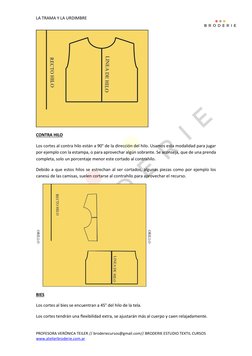
Con tecnología de IAPatterns might be intentionally cut on the cross grain to utilize specific patterns or designs on the fabric that align better crosswise, or to optimize the use of fabric remnants . Although cutting on the cross grain can lead to more stretch and less stability, it might be chosen for aesthetic reasons, such as certain designs that appear visually more appealing or coherent when cut this way. This technique may also be employed in specific garment parts like shirt yokes where a slight stretch or a different visual texture might be desirable .
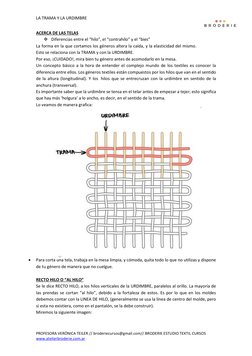
Understanding the 'trama' (weft) and 'urdimbre' (warp) is essential for achieving the desired fabric properties and garment fit. The urdimbre refers to the longitudinal threads, which are placed under tension on the loom, creating a more stable fabric structure and reducing stretch along this direction . On the other hand, the trama, being more relaxed, allows for stretch across the fabric, affecting the fabric's drape and elasticity. Thus, knowing these properties helps in positioning patterns accurately on the fabric, impacting the final look and performance of the textile project .
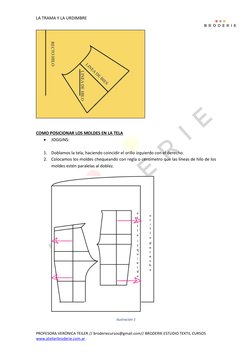
When positioning patterns on fabric, it is important to ensure that the 'linea de hilo' or grain line of the patterns aligns with the fabric grain to maintain the garment's fit and aesthetic integrity . The fabric should be laid out on a clean and clear surface, ensuring no part hangs over the edge, which could distort the fabric grain . For special features of the design, such as using the bias cut for better fit and drape, the pattern should be placed at a 45° angle to the selvage .
The concepts of warp (urdimbre) and weft (trama) are fundamental in textile engineering as they determine the structural integrity and intended use of fabric materials. The warp threads, which are held under tension during weaving, ensure the fabric's dimensional stability, essential for creating durable and robust textiles used in industrial applications . Weft threads provide width and contribute to the fabric's elasticity, influencing decisions on fabric application in fashion design that require flexibility . Mastery of these concepts enables the development of specialized materials that meet specific strength, flexibility, and aesthetic requirements .
Cutting fabric on the straight grain, known as 'recto hilo' or 'al hilo,' involves aligning the fabric’s threads parallel to the edges (selvage), providing strength and stability, which is why most garments are cut this way . Cutting on the cross grain, or 'contra hilo,' takes place at a 90° angle to the straight grain, primarily used for playing with patterns or using leftover fabric, even though it makes the fabric more susceptible to stretching . The bias cut is at a 45° angle to the fabric threads and gives more flexibility and stretch, allowing the fabric to drape more naturally, which is ideal for clothing that needs to mold to the body .
Understanding fabric grain is crucial in constructing tailored clothing as it affects how the fabric hangs and behaves. Tailored pieces, which require precise fit and sharp lines, benefit from using the fabric's straight grain, which provides alignment, control, and stability, crucial for structured garments like suits and blazers . Proper grain alignment ensures that seams align correctly and the garment maintains its intended shape and drape over time, thus enhancing both aesthetics and durability .
Fabric orientation significantly impacts the strength and elasticity of the garment. Cutting along the straight grain (warp) gives the garment more strength and stability, reducing stretch and maintaining shape over time . Conversely, cutting along the bias increases flexibility and allows the garment to conform better to body shapes due to increased elasticity, ideal for close-fitting garments . Cross grain has moderate impact, often used less for its structural properties and more for aesthetic purposes .
The choice of fabric cut directly influences garment aesthetics by dictating how patterns, prints, and structural elements present on the body. For example, a bias cut enhances drape and fluidity, creating a sensual, flowing look ideal for evening wear . Conversely, straight grain cuts maintain structure and are preferred for tailored designs, providing a clean, crisp silhouette . Functionally, bias cuts offer more stretch and movement, but also require careful handling during construction to prevent distortion, while straight cuts are more stable and straightforward in handling .
Aligning the fabric edges before cutting is crucial to maintain grain line consistency throughout the fabric piece, which affects the strength and drape of the finished garment . Misalignment can result in garments that do not fit or hang correctly, as it could inadvertently place parts of the fabric on the unintended grain direction, leading to skewed seams and poor overall appearance .
Cutting fabric on the bias offers benefits such as enhanced elasticity and a graceful drape, making it ideal for form-fitting garments that require a closer, more adaptive fit to the body, such as dresses or skirts . This cut allows for natural movement and can significantly enhance the flow and hang of a garment. However, challenges include potential difficulties in handling due to increased stretch, the risk of fabric distortion during cutting and construction, and greater wastage of fabric due to the diagonal pattern layout .